

Serviços//Sete áreas de prática
De protocolos de campo a entregas analíticas
Sete áreas de prática complementares, cobrindo todo o arco da medição de campo e do desenho metodológico até o suporte científico à decisão.
Expert review & advisory
An independent expert on the science you're relying on
You are running a big project and a service provider is doing the work. You rely on their methods and their numbers, but you do not always have the time to follow every step, or the expertise in-house to judge whether the science holds up. An independent expert closes that gap: someone with no stake in the deliverable, who can look hard at the science and tell you where it is sound and where it is not. Sometimes that means a full review. Sometimes it is one call on one decision. You decide how much you need.
Independent review of the work
We examine a service provider's methodology, sampling design, model, or results, and give you a clear read on whether they meet the standard your decision needs. Often the entry point is a soil or tree sampling protocol: we check it before the campaign starts, because carbon accounting asks more of a protocol than ordinary agronomic sampling does.
A call, or a second opinion
Sometimes you need one question answered well, not a whole engagement. A short call, a second opinion, or written advice on a specific choice you are about to commit to: an indicator, a target, a claim, a method.
A subject-matter expert on hand
For a program already under way, we step in on the specific things where deep expertise earns its keep: a protocol to pressure-test, a result that needs interpreting, an assumption worth checking before everything rests on it. You get scientific scrutiny where it counts, without adding a scientist to the payroll.
Where we work
Five domains, one practice
Distinct fields of expertise. Most projects pull from two or three at once.
Soils
The physical, chemical, and biological substrate of every land project. We work at research grade: soil health, characterization, biology, and the sampling logic that makes any downstream claim defensible.
Carbon
Soil carbon baselines, biomass accounting, MRV, aligned with the GHG Protocol Land Use Removals guidance and with the practical reality of supplier programs. We aim for numbers that survive a serious audit.
Agroforestry & trees
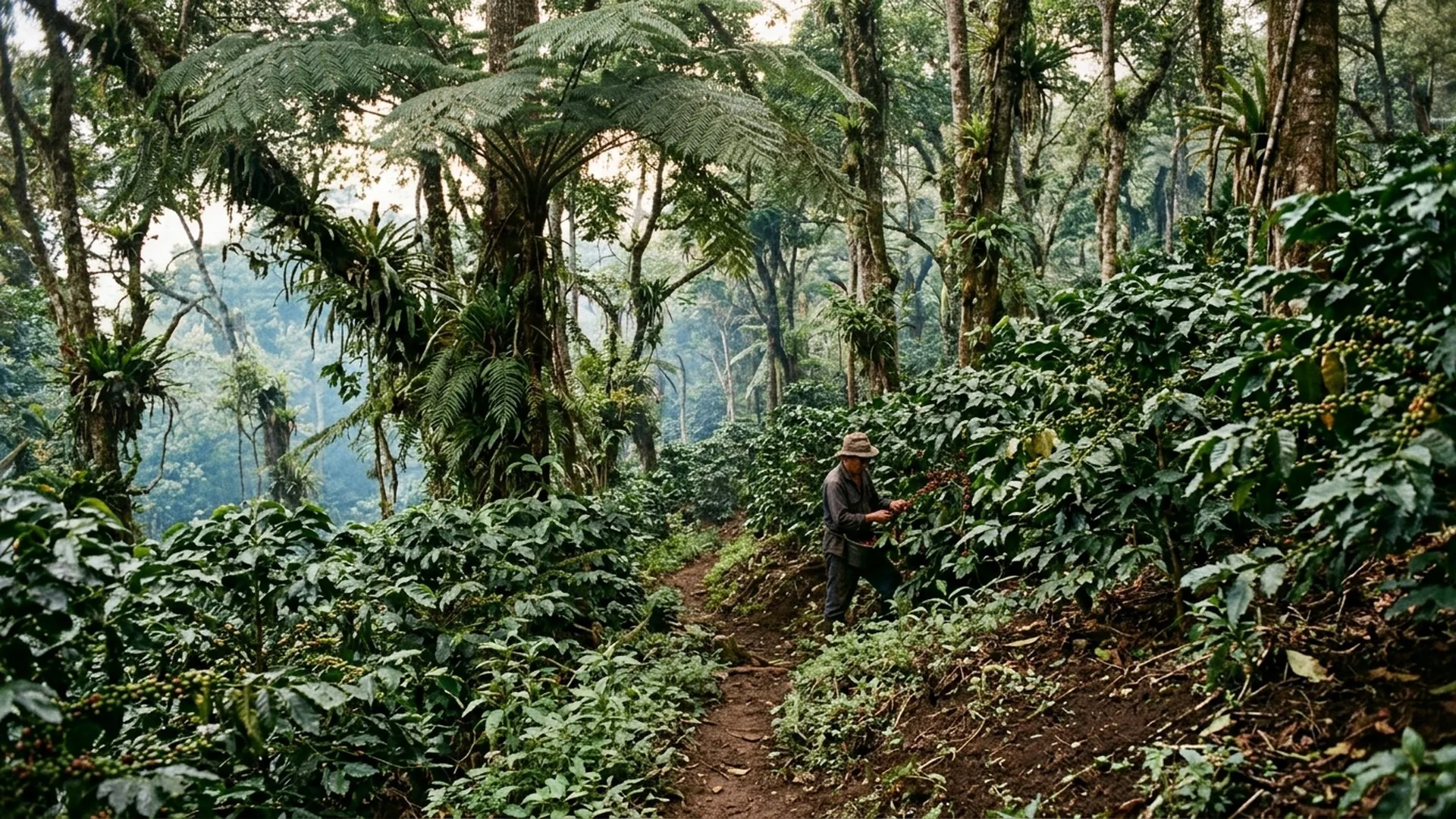
Trees inside production systems: allometry, biomass, shade dynamics, remnant-tree carbon. The estimation methods that matter when the trees aren't in a plantation but scattered through farms.
Farm systems & modeling
Whole-farm dynamics, short-term and long-term. The models show how management choices translate into emissions, yields, removals, and the trade-offs between them that don't usually make it into the slide deck.
Science & evidence
The methodological backbone underneath everything else: sampling design, literature synthesis, peer review, capability-building. Less a domain in itself than the standards we apply across the others.
What you receive
Twelve concrete things we ship
These aren't packages or tiers. They're individual artifacts you can commission on their own, or stack into a larger engagement.
Sampling design + protocol review
A statistically defensible field campaign plan, or an independent second opinion on a plan your team or vendor has already put forward.
Soil characterization report
Field- and lab-based soil profiles. Physical, chemical, and biological properties, interpreted rather than just tabulated.
Soil carbon baseline
Stock estimation at project or supplier-shed scale, with the depth, bulk density, and uncertainty treatment carbon accounting actually requires.
Biomass & allometry assessment
Above- and below-ground biomass estimates for plantations, agroforestry, or scattered trees, with allometric models matched to the actual context.
Statistical model or scenario analysis
Mixed models, simulations, scenario comparisons. To test what your data actually says, or project how a management change will play out.
Decision-support dashboard or app
Interactive tools your team can use day-to-day, not slide decks they'll archive. Built around the specific question that matters.
Hand-drawn diagram or spatial map
When the right output is a clear figure, not a report. System diagrams, soil cross-sections, project maps, all drawn for the audience.
Literature review or decision brief
Vast or contradictory science compressed into a sourced, opinionated memo your decision-makers can actually read.
Training workshop or curriculum
Tailored capability-building for in-house teams. The working knowledge your people need to do the job well, without the certification theatre.
Independent peer review
A senior scientific read on someone else's methodology, results, or protocol, before publication, audit, or commitment.
Custom MRV or methodology document
The protocol document itself: how a project will measure, report, and verify, written to survive third-party scrutiny.
Bespoke scientific tool or web build
When the deliverable should live on the web: calculators, visualization tools, public-facing science.
Nossa postura
A agricultura precisa de ciência. A ciência precisa estar enraizada na realidade agrícola
Entregar resultados eficazes exige mais do que conhecimento técnico. Requer uma perspectiva dupla: aplicar pesquisa rigorosa e independente para resolver problemas complexos, garantindo, ao mesmo tempo, que essas metodologias sejam de fato funcionais no solo e gerenciáveis em campo.
Como não existem modelos universais para sistemas agrários vivos, nosso trabalho preenche essa lacuna. Ancoramos nossa abordagem na transparência analítica e na utilidade prática: uma interação entre teoria científica e realidade vivida que orienta todo o nosso fluxo de trabalho.
Processo // Como trabalhamos
Um fluxo científico em cinco etapas
- 01/05
Enquadramento do problema
Começamos esclarecendo qual é a decisão real que os dados devem apoiar, o contexto em que ela vive e as restrições (orçamento, geografia, prazos) que definem o rigor efetivamente possível.
- 02/05
Proposta e metodologia
Uma proposta técnica escrita com abordagem metodológica defensável, entregáveis claros, hipóteses e orçamento de incerteza. Nunca genérica, sempre sob medida.
- 03/05
Execução colaborativa
Trabalhamos com sua equipe e parceiros de campo. Os protocolos são testados, ajustados e documentados em ciclo. Você fica informado em cada etapa.
- 04/05
Análise e interpretação
Análise estatística, modelagem ou síntese independentes, com tratamento honesto da incerteza e separação clara entre o que os dados mostram e o que implicam.
- 05/05
Entrega e próximos passos
Um entregável revisável e pronto para decisão: relatório, conjunto de dados, ferramenta ou metodologia. Continuamos disponíveis para perguntas, defesa em auditoria ou próxima iteração.
Trabalhe conosco
Pronto para escopar um projeto?
You do not need a full engagement to start. Often the right first step is smaller: a review, a second opinion, a single call. The first conversation is free, and always honest.