

Services//Seven practice areas
From field protocols to analytical outputs
Seven complementary practice areas covering the full arc from field measurement and methodology design to scientific decision-support.
Expert review & advisory
An independent expert on the science you're relying on
You are running a big project and a service provider is doing the work. You rely on their methods and their numbers, but you do not always have the time to follow every step, or the expertise in-house to judge whether the science holds up. An independent expert closes that gap: someone with no stake in the deliverable, who can look hard at the science and tell you where it is sound and where it is not. Sometimes that means a full review. Sometimes it is one call on one decision. You decide how much you need.
Independent review of the work
We examine a service provider's methodology, sampling design, model, or results, and give you a clear read on whether they meet the standard your decision needs. Often the entry point is a soil or tree sampling protocol: we check it before the campaign starts, because carbon accounting asks more of a protocol than ordinary agronomic sampling does.
A call, or a second opinion
Sometimes you need one question answered well, not a whole engagement. A short call, a second opinion, or written advice on a specific choice you are about to commit to: an indicator, a target, a claim, a method.
A subject-matter expert on hand
For a program already under way, we step in on the specific things where deep expertise earns its keep: a protocol to pressure-test, a result that needs interpreting, an assumption worth checking before everything rests on it. You get scientific scrutiny where it counts, without adding a scientist to the payroll.
Where we work
Five domains, one practice
Distinct fields of expertise. Most projects pull from two or three at once.
Soils
The physical, chemical, and biological substrate of every land project. We work at research grade: soil health, characterization, biology, and the sampling logic that makes any downstream claim defensible.
Carbon
Soil carbon baselines, biomass accounting, MRV, aligned with the GHG Protocol Land Use Removals guidance and with the practical reality of supplier programs. We aim for numbers that survive a serious audit.
Agroforestry & trees
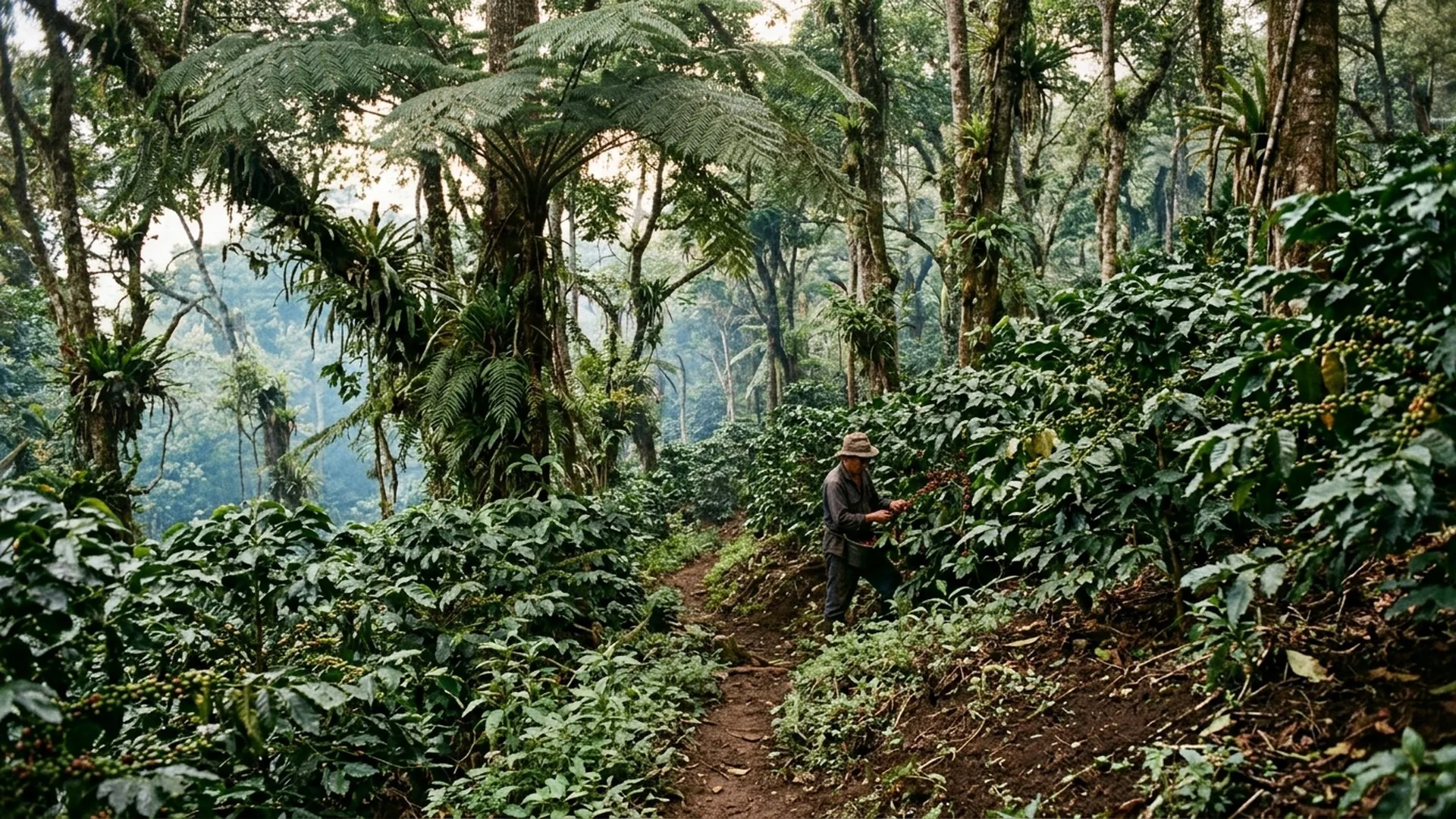
Trees inside production systems: allometry, biomass, shade dynamics, remnant-tree carbon. The estimation methods that matter when the trees aren't in a plantation but scattered through farms.
Farm systems & modeling
Whole-farm dynamics, short-term and long-term. The models show how management choices translate into emissions, yields, removals, and the trade-offs between them that don't usually make it into the slide deck.
Science & evidence
The methodological backbone underneath everything else: sampling design, literature synthesis, peer review, capability-building. Less a domain in itself than the standards we apply across the others.
What you receive
Twelve concrete things we ship
These aren't packages or tiers. They're individual artifacts you can commission on their own, or stack into a larger engagement.
Sampling design + protocol review
A statistically defensible field campaign plan, or an independent second opinion on a plan your team or vendor has already put forward.
Soil characterization report
Field- and lab-based soil profiles. Physical, chemical, and biological properties, interpreted rather than just tabulated.
Soil carbon baseline
Stock estimation at project or supplier-shed scale, with the depth, bulk density, and uncertainty treatment carbon accounting actually requires.
Biomass & allometry assessment
Above- and below-ground biomass estimates for plantations, agroforestry, or scattered trees, with allometric models matched to the actual context.
Statistical model or scenario analysis
Mixed models, simulations, scenario comparisons. To test what your data actually says, or project how a management change will play out.
Decision-support dashboard or app
Interactive tools your team can use day-to-day, not slide decks they'll archive. Built around the specific question that matters.
Hand-drawn diagram or spatial map
When the right output is a clear figure, not a report. System diagrams, soil cross-sections, project maps, all drawn for the audience.
Literature review or decision brief
Vast or contradictory science compressed into a sourced, opinionated memo your decision-makers can actually read.
Training workshop or curriculum
Tailored capability-building for in-house teams. The working knowledge your people need to do the job well, without the certification theatre.
Independent peer review
A senior scientific read on someone else's methodology, results, or protocol, before publication, audit, or commitment.
Custom MRV or methodology document
The protocol document itself: how a project will measure, report, and verify, written to survive third-party scrutiny.
Bespoke scientific tool or web build
When the deliverable should live on the web: calculators, visualization tools, public-facing science.
Our posture
Agriculture needs science. Science must be rooted in agricultural reality
Delivering effective outcomes requires more than just technical know-how. It demands a dual perspective: applying rigorous, independent research to solve complex problems, while ensuring those methodologies are actually functional in the soil and manageable in the field.
Because there are no universal templates for living land systems, our work bridges this gap. We anchor our approach in analytical transparency and practical usability: an interplay between scientific theory and lived reality that guides our entire workflow.
Process // How we work
A five-stage scientific workflow
- 01/05
Problem framing
We start by clarifying the real decision you need the data to support, the context it lives in, and any constraints (budget, geography, deadlines) that shape what rigor is actually possible.
- 02/05
Proposal & methodology
A written technical proposal with a defensible methodological approach, clear deliverables, assumptions, and an uncertainty budget. Never boilerplate, always tailored.
- 03/05
Collaborative execution
We work alongside your team and field partners. Protocols are tested, adjusted, and documented as we go. You stay in the loop at every stage.
- 04/05
Analysis & interpretation
Independent statistical analysis, modelling, or synthesis, with honest treatment of uncertainty and a clear separation between what the data shows and what it implies.
- 05/05
Delivery & next steps
A reviewable, decision-grade output: report, dataset, tool, or methodology. We stay available for follow-up questions, audit defense, or the next iteration.
Work with us
Not sure you need a full study? Start smaller
You do not need a full engagement to start. Often the right first step is smaller: a review, a second opinion, a single call. The first conversation is free, and always honest.